

Assessment means more than just a standardised test
We believe psychological assessment should feel safe, collaborative and genuinely useful.
At Paper Trails, every assessment begins with curiosity, care, and a respectful, individualised approach, ensuring that every young person’s story is genuinely understood. We create a calm and welcoming space where children and young people feel respected, supported, and able to be themselves. We take time to understand the whole person — their strengths, challenges, relationships, experiences and story — so the assessment captures more than test results alone.
Our assessments are evidence-informed, developmentally sensitive and grounded in connection. We aim to provide clear answers, meaningful insights and practical recommendations. Our reports are written in a way that families, schools and, most importantly, young people themselves can actually understand. We want each young person and their family to leave with a deeper understanding of themselves, greater confidence in their strengths, and a clearer path forward.
Our Approach to Assessment
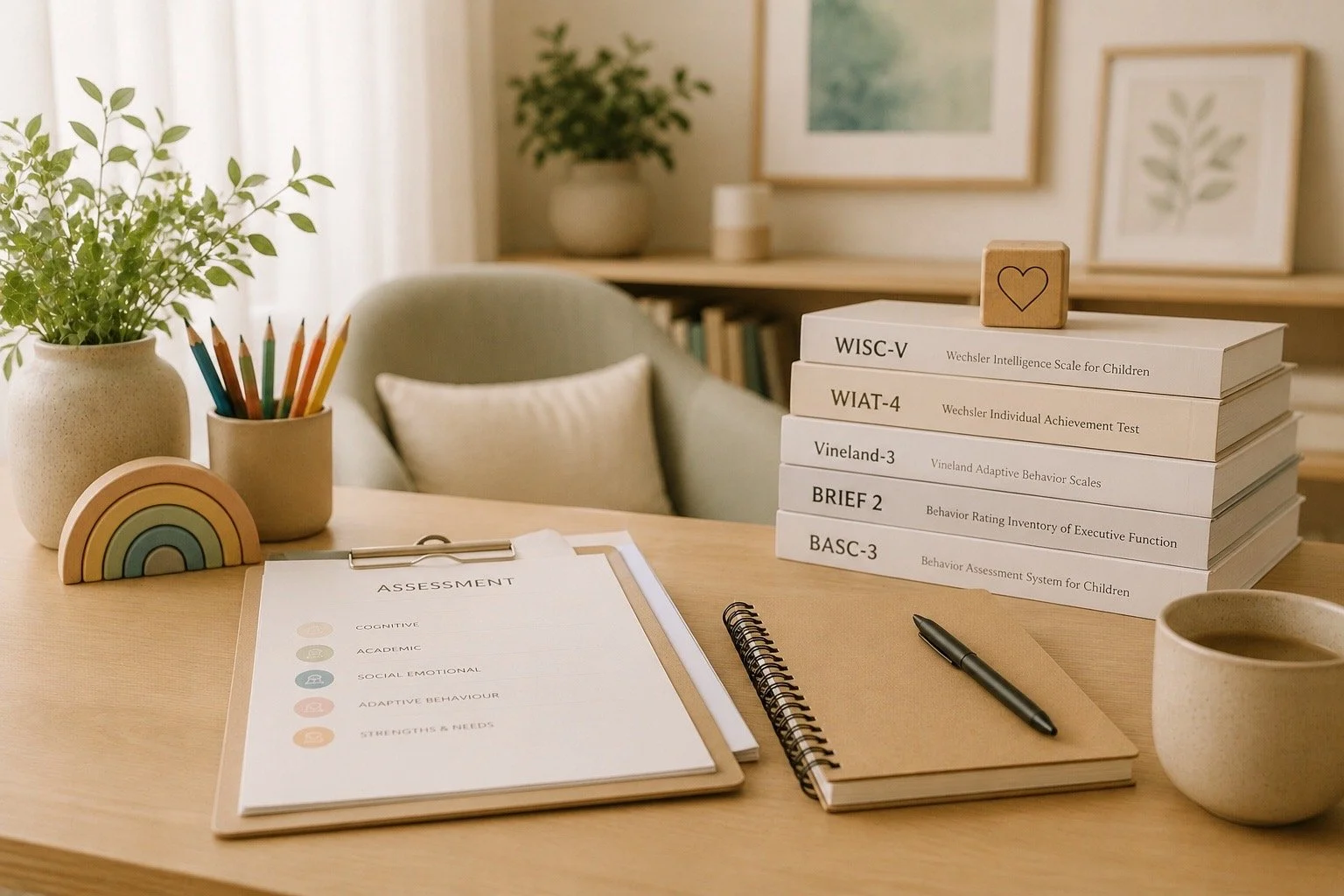
Assessments
The assessment options below are provided as a guide. Every assessment is tailored to the individual child and referral questions. Following an initial consultation, we'll recommend the most appropriate assessment pathway and provide a personalised quote before the assessment begins.
Assessment fees are based on $230 per hour, including assessment sessions, administration, scoring, interpretation, report writing and the feedback session.
-
A cognitive assessment helps us understand how a young person thinks, learns and processes information. It explores areas such as reasoning, problem-solving, memory, attention and processing speed, helping to identify both strengths and areas where additional support may be needed.
You might benefit from a cognitive assessment if your child is experiencing learning difficulties, working significantly above or below age expectations, or you would like a clearer understanding of how they think and learn.
Assessment tools may include:
WISC–V (Wechsler Intelligence Scale for Children – Fifth Edition)
WPPSI–IV (for younger children, where appropriate)
Clinical observations/interviews
Parent, teacher and school information
-
An adaptive functioning assessment explores how a young person manages the everyday skills needed for independence and daily life. It helps identify both the skills they already demonstrate with confidence and the areas where additional support may foster greater independence and participation.
You might benefit from an adaptive functioning assessment if there are questions about your child’s independence, everyday life skills or developmental functioning, or if further information is needed to support diagnosis, educational planning, NDIS applications or access to additional services.
Assessment tools may include:
Vineland-3 (Vineland Adaptive Behavior Scales – Third Edition)
Parent and caregiver interview
Information gathered from parents, schools and other relevant professionals (with consent)
Review of previous assessments
-
A cognitive and adaptive functioning assessment provides a comprehensive understanding of how a young person thinks, learns and manages the everyday demands of life. By exploring both cognitive abilities and practical daily living skills, this assessment helps build a complete picture of a young person’s strengths, support needs and overall functioning across home, school and the community.
You might benefit from this assessment if there are questions about intellectual functioning, developmental differences, adaptive skills or eligibility for additional supports such as the NDIS.
Assessment tools may include:
WISC–V
Vineland-3 Adaptive Behavior Scales
Clinical interview
Parent, teacher and school information
-
A comprehensive assessment that explores thinking skills, everyday functioning, emotional wellbeing and behaviour to develop a holistic understanding of the young person and their support needs.
You might benefit from this assessment if concerns span multiple areas of development or you would like a more complete understanding to guide intervention, educational planning or future support.
Assessment tools may include:
WISC–V
Vineland-3
BASC-3
Clinical interview
Behavioural observations
Parent, teacher and school questionnaires
-
A learning assessment explores both how a young person thinks and how they are performing academically. By understanding the relationship between cognitive abilities and learning skills such as reading, writing and mathematics, we can identify learning strengths, clarify areas of difficulty, and provide recommendations to support success at school and beyond.
You might benefit from a learning assessment if your child is finding learning more difficult than expected, their academic progress does not reflect their potential, or there are concerns about a specific learning disorder such as dyslexia, dysgraphia or dyscalculia.
Assessment tools may include:
WISC–V (Wechsler Intelligence Scale for Children – Fifth Edition)
WIAT–III (Wechsler Individual Achievement Test – Third Edition)
Clinical observations
Review of school reports and previous assessments (where available)
Parent, caregiver and teacher questionnaires
Information gathered from parents, schools and other relevant professionals (with consent)
-
An Educational Needs Analysis (ENA) brings together assessment findings to identify the adjustments, strategies and supports that will best meet a young person’s learning needs within the school environment. It provides practical, individualised recommendations to help schools understand how a student learns and what they need to participate, engage and achieve alongside their peers.
You might benefit from an Educational Needs Analysis if your child requires additional support at school, reasonable adjustments are being considered, or you would like clear, evidence-informed recommendations to guide educational planning and classroom support.
Assessment tools may include:
Review of previous psychological assessments (where available)
School observations (where appropriate)
Consultation with parents, caregivers and school staff
Review of educational reports and school documentation
Clinical interview
Additional assessment, where required
An ENA may be completed following a previous psychological assessment or as a standalone service where recent assessment information is already available. Where further assessment is required, we can provide a comprehensive Educational Needs Analysis incorporating cognitive, academic, emotional and behavioural assessment. This may include the WISC-V, WIAT-III and BASC-3, allowing us to develop a thorough understanding of a young person’s learning profile and provide practical, evidence-informed recommendations for school and home.
-
An ADHD assessment explores whether attention, hyperactivity and impulsivity may be contributing to a young person’s learning, behaviour and everyday functioning. We take a comprehensive approach, gathering information from parents, teachers and the young person to understand how these experiences present across different environments.
This assessment is suitable when a comprehensive cognitive assessment has already been completed within the past two years.
You might benefit from an ADHD assessment if your child is experiencing ongoing difficulties with attention, organisation, impulsivity, emotional regulation or executive functioning, and recent cognitive assessment results are already available.
Assessment tools may include:
Clinical interview
Developmental and medical history
Parent and teacher questionnaires
Conners 4
BRIEF-2
Review of previous cognitive assessment (completed within the past two years)
Information from schools and other professionals (with consent)
-
A comprehensive ADHD assessment combines a full cognitive assessment with a detailed ADHD evaluation, providing a complete understanding of how a young person thinks, learns and manages attention, executive functioning and everyday demands. By exploring both cognitive abilities and ADHD symptoms together, we can develop a clearer understanding of your child’s unique strengths, challenges and support needs.
You might benefit from a comprehensive ADHD assessment if your child has not previously completed a cognitive assessment, or if you would like a thorough understanding of both their learning profile and whether ADHD may be contributing to their difficulties.
Assessment tools may include:
WISC-V (Wechsler Intelligence Scale for Children – Fifth Edition)
Clinical interview
Developmental and medical history
Conners 4
BRIEF-2 (where appropriate)
Parent and teacher questionnaires
Clinical observations
Information from schools and other professionals (with consent)
-
Assessment is an investment into your child’s
Fees are indicative only and may vary depending on the referral questions, complexity of the assessment and any additional information required.
Cognitive Assessment- $1,610
Adaptive Functioning Assessment- $920
Cognitive & Adaptive Functioning Assessment- $2,070
Comprehensive Psychological Assessment- $2,300
Learning Assessment- $2,760
Educational Needs Analysis - Price varies from $1,610 to $2,760
ADHD Assessment- $2,070
Comprehensive ADHD Assessment- $2,530